Cellular Idle-Mode Mobility Management
Idle-mode mobility management in LTE, GSM/WCDMA, and CDMA is based on common principles. The UE periodically informs the network of its location. Since cellular networks contain cells ranging in size from a few tens or hundreds of meters to several tens of kilometers, requiring an idle UE to update its location every time it moves between cells would generate excessive signalling. Similarly, searching for the UE throughout the entire network whenever a terminating event occurs, such as an incoming call, would be impractical. Therefore, neighbouring cells are grouped into larger areas known as registration areas.
Every base station periodically broadcasts a registration area identifier. A UE listens to this broadcast and checks it against the registration area identifier it has stored previously. As long as the two match, the UE assumes its location is already known to the network and takes no action. Once they diverge — meaning the UE has moved into a new registration area — the UE initiates an update procedure, notifying the network of its new registration area.
In EPS, the registration areas are called Tracking Areas (TAs). A Tracking Area is a group of cells sharing the same Tracking Area Code (TAC), which together with the PLMN identity forms the Tracking Area Identity (TAI) that uniquely identifies that TA from the network's point of view. A UE is allocated a Tracking Area list (TAI list) of up to 16 TAIs by the MME. As long as the UE remains within its allocated TAI list, no tracking area update (TAU) is required, even as it moves between cells and TAs within that list.
In LTE, the MME forms and maintains a TAI list per UE. The MME typically constructs a UE's TAI list based on its current TA together with neighbouring or overlapping TAs, though it can also be tailored using UE-specific mobility history or statistics — allocating smaller lists to UEs with predictable, contained movement and larger lists to UEs that roam widely, or dynamically adjusting the list so that a UE's typical path crosses fewer boundaries. The full TAI list is sent to the UE in NAS signalling (e.g., during Attach or Tracking Area Update) by the MME and stored in the UE.
Each eNodeB is configured with one or more TACs (Tracking Area Codes) and broadcasts the corresponding TAI (MCC + MNC + TAC) in its system information (SIBs). During S1 setup, eNodeBs also inform the MME about their supported TAIs, so the MME knows which TACs belong to which cells and can construct appropriate TAI lists.
Each cell broadcasts its own TAI (not the full list) in system information so that the UE can detect which Tracking Area it is currently in. The UE then compares the broadcast TAI with this stored list to decide whether an update is needed.
Beyond the TAU triggered by crossing into an unregistered TA, EPS defines periodic TAU: the network broadcasts a periodic update timer (T3412), and the UE must re-register before this timer expires if no other NAS signalling has occurred. This mechanism allows the network to reclaim resources held for UEs that have gone out of coverage or been powered off without a proper detach.
Note that TAU procedures, and the TAI list concept generally, apply to UEs in idle mode (ECM-IDLE). Mobility for UEs in connected mode is handled through handover, not TAU.
The size of tracking areas and TAI lists is fundamentally a trade-off between two signalling loads. Smaller TAs mean fewer cells need to be paged when locating a UE, reducing paging load — but the UE crosses TA boundaries more often, increasing TAU signalling. Larger TAs reduce TAU frequency but increase paging load, since more cells must be paged per attempt. TAI lists give the operator a further degree of freedom here, since list size can be tuned per UE: UEs that are paged frequently (e.g. due to high traffic) can be given smaller TAI lists to keep paging load down, while UEs paged infrequently can be given larger lists to minimize TAU signalling, and — where mobility is predictable — the list contents themselves can be adapted to reduce the number of borders a given UE is likely to cross.
In GSM and WCDMA, two separate registration-area concepts are used: one for the Packet‑Switched (PS) domain (Routing Areas, RAs) and other one for the Circuit‑Switched (CS) domain (Location Areas, LAs). A Routing Area is always a subset of a Location Area, and cells from the same LA can be grouped into one or more RAs. Unlike LTE, GSM/WCDMA do not support lists of Routing or Location Areas, so all UEs share the same RA and LA boundaries.
An optimization introduced in these systems exploits the fact that each RA is contained within a single LA: the UE can perform a combined RAU/LAU when it crosses an RA boundary, avoiding a separate LAU. This requires support in both the UE and the network; it has seen significant deployment in GSM but has been less widely adopted in WCDMA.
An outline of the Tracking Area Update procedure is shown in the figure below, and it contains the following steps:
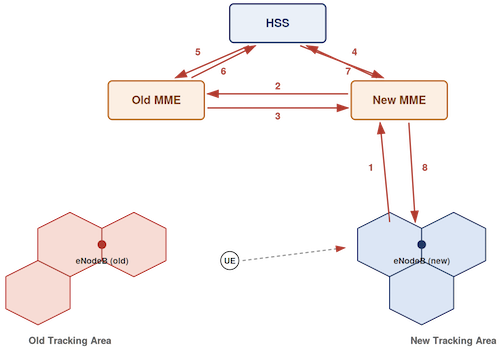
Fig: Tracking Area Update (Inter-MME) procedure
- When the UE reselects a new cell and realizes that the TAI broadcast by the eNodeB is not in its stored TAI list, it initiates a TAU procedure by sending a Tracking Area Update Request message to the MME.
- On receiving this message, the MME checks whether it already holds a context for that UE. If not, it examines the UE's temporary identity — specifically, the MMEC embedded within its GUTI, to determine which node (the "old" MME) must be holding the UE's context, and requests that context from it.
- The old MME transfers the UE's context to the new MME.
- On receiving this context, the new MME informs the HSS that the UE's context has now moved to it.
- The HSS sends a cancellation request for the UE's context to the old MME.
- The old MME takes the necessary steps and sends a Cancel Location Answer (CLA) to the HSS.
- The HSS acknowledges the new MME and inserts the subscriber's data into it.
- The MME informs the UE that the TAU was successful, supplying a new GUTI, in which the MME Code now points to the new MME.