SMS Delivery Architecture in LTE Networks: SMS over NAS and SMS over IMS
Service Requirements for SMS
As specified in 3GPP TS 22.003, the Short Message Service (SMS) teleservice is required to be supported by a Public Land Mobile Network (PLMN), including service interaction with other networks. These service-level requirements define the expected SMS capabilities from the user's perspective and provide the basis for deriving the network capabilities and architectural solutions required to support SMS across different access technologies.
Types of SMS Services
Three different types of short messages are defined:
1. Short Message MT/PP (Mobile Terminated/Point-to-point)
- Transmission of a short message from SMS-SC to a user equipment. After reception an acknowledgement message is sent back.
2. Short Message MO/PP (Mobile Originated/Point-to-point)
- Transmission of a short message from user equipment to SMS-SC After reception an acknowledgement message is sent back.
- Information from the following sources at the UE might be transmitted
- - A pre-recorded message in a store;
- - A number from the dialling key pad;
- - Information from an external keyboard or terminal equipment connected to the ME.
3. Cell Broadcast Service messages
- This service provides the transmission of a short message from a message handling system to all user equipment’s in the area of a Base Station. There is no acknowledgement message after reception.
- Cell-Broadcast Service Centre to connections from fixed network is out-of-scope.
Originated and Mobile Terminated Point-to-Point SMS Services
For both Mobile Originated (SMS-MO) and Mobile Terminated (SMS-MT) services, one or more Short Message Service Centres (SMS-SC) provide the store-and-forward capability. The SMS-SC is functionally separate from the PLMN and is responsible for receiving, storing, processing, and forwarding short messages towards the destination.
Messages may be submitted to the SMS-SC by users from mobile networks, fixed networks, or other external messaging sources. The SMS-SC prepares the message in the required format for delivery towards the recipient UE. The maximum payload of a single SMS message is 140 octets (140 bytes). Depending on the character encoding used, this corresponds to up to 160 characters using the GSM 7-bit default alphabet. The message originator does not need to know the current location or serving network of the recipient. The short message is addressed using the recipient's directory number, and the network determines the appropriate delivery path.
For point-to-point SMS communication, all messages pass through the SMS-SC. A message sent from one UE to another consists of two logically separate transactions:

Fig 1 : Point-to-Point SMS
Although the SMS-MO and SMS-MT procedures are related as part of the same end-to-end service, they are handled as independent transactions.
As part of the basic SMS service, an acknowledgement is provided for each transaction:
- For SMS-MO, acknowledgement confirms successful transfer of the message from the UE to the SMS-SC.
- For SMS-MT, acknowledgement confirms successful transfer of the message from the PLMN to the recipient UE.
This acknowledgement only confirms successful message transfer at that stage and does not indicate that the recipient has read the message.
The SMS-SC may optionally provide a delivery report service to the originator. When requested, the SMS-SC informs the originator whether the message was successfully delivered to the recipient or whether delivery failed. In case of failure, the delivery report includes the appropriate failure cause. The SMS-SC may also use reporting capabilities to provide intermediate message status information.
Short messages may be sent or received while the UE is idle or engaged in another service such as voice or data. If delivery is interrupted due to events such as mobility procedures or temporary radio conditions, the SMS-SC store-and-forward mechanism enables further delivery attempts.
The originator may specify a validity period for the short message. The SMS-SC attempts delivery during this validity period. If the message cannot be delivered before expiry, no further delivery attempts are made, although message status information may be retained for enquiry purposes. If no validity period is provided by the originator, a default value configured by the service provider is applied.
The SMS-SC may assign priority handling to selected short messages. A priority message may be attempted even when the recipient UE was previously identified as temporarily unavailable, whereas delivery attempts for normal priority messages may be deferred until the UE becomes reachable.
The originator may also request supported message management operations from the SMS-SC, such as requesting or cancelling reports or deleting previously submitted messages.
For successfully delivered messages, the recipient is provided with the timestamp indicating when the message was originally submitted to the SMS-SC.
SMS Transport Mechanisms in LTE
LTE supports two mechanisms for SMS delivery: SMS over NAS and SMS over IMS. SMS over NAS transports SMS using NAS signalling between the UE and the MME, with the MME forwarding the message to the legacy MSC Server over the SGs interface. This approach enables existing SMS infrastructure to be reused without requiring IMS support. In contrast, SMS over IMS transports SMS using SIP signalling through the IMS network and the IP-SM-GW. The GSMA IR.92 IMS Profile for Voice and SMS profiles both mechanisms and specifies the conditions under which each mechanism is applicable in VoLTE deployments.
SMS Over NAS
SMS over NASin LTE networks refers to the transport of Short Message Service (SMS) using Non-Access Stratum (NAS) signalling instead of IMS signalling or circuit-switched signalling. It is commonly known as SMS over SGs in LTE networks.
During initial deployment of LTE (EPS):
-
- LTE may support only packet-switched services.
- Circuit-switched (CS) voice and SMS infrastructure will still exist
- VoLTE and SMS over IMS may not yet be deployed.
3GPP introduced SMS over NAS, allowing SMS to be transported over LTE signalling as a mechanism to continue providing SMS while the UE remained attached to LTE, rather than moving the UE to 2G/3G for every SMS.
SMS over IMS Architecture
IP-Short-Message-Gateway (IP-SM-GW)
An IP-SM-GW for transport layer interworking provides the protocol interworking for the submission of short messages from the SM-over-IP sender to the SMS-SC, for the delivery of short messages from the SC to the SM-over-IP receiver, and for the SMS-Status Reports from the SC to the SM-over-IP sender.
An IP-SM-GW in MSISDN less operation provides for SIP MESSAGE based submission of short messages from the SM-over-IP sender to the SM-over-IP receiver, of SMS Submit Reports to the SM-over-IP sender and SMS-Status Reports to the SM-over-IP sender.
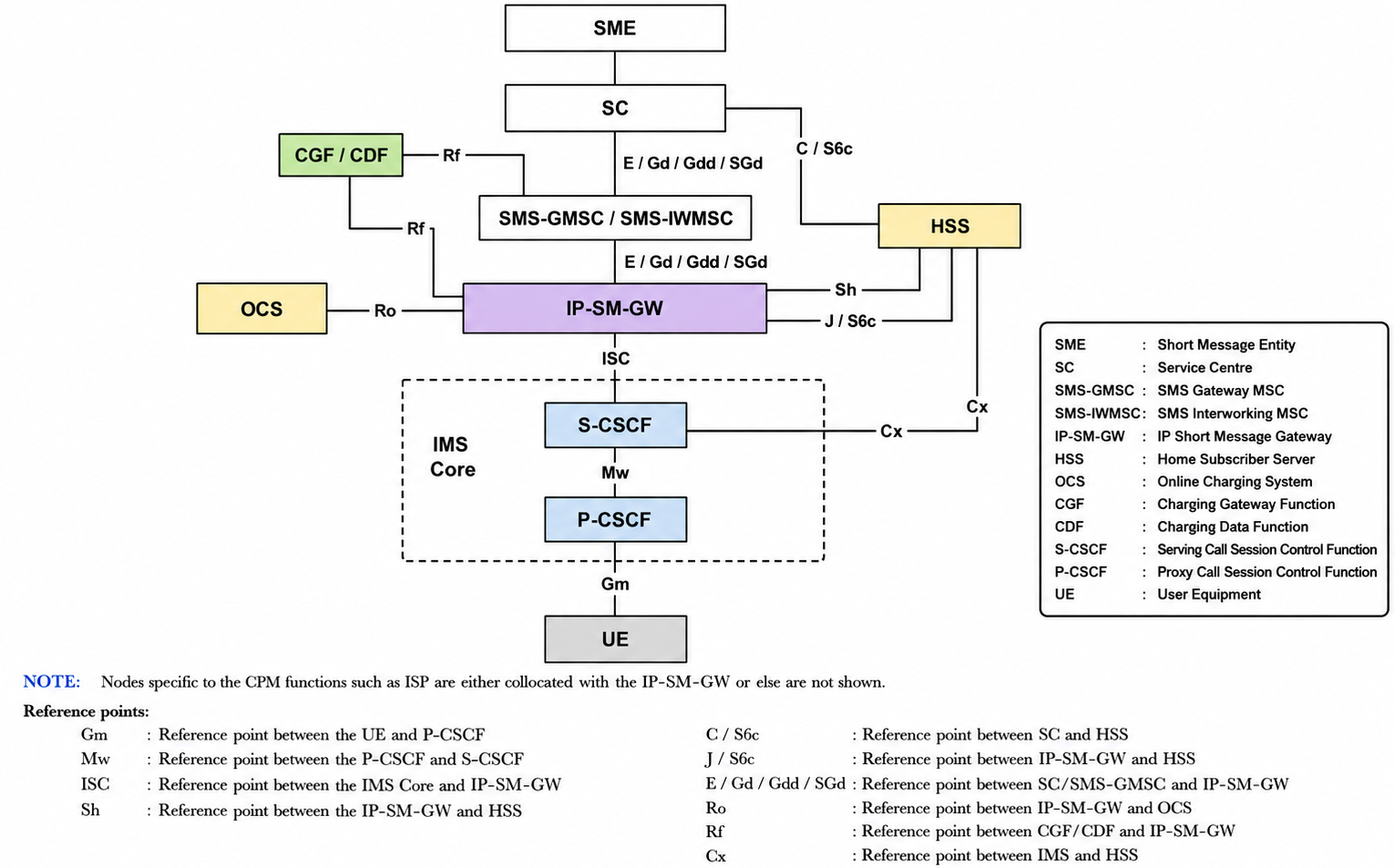
Fig 2 : SMS Over Generic IP-CAN
Short Message origination procedure
- UE submits the encapsulated Short Message (SMS-SUBMIT, SC Address) to the S-CSCF using an appropriate SIP method.
- S-CSCF forwards the encapsulated Short Message (SMS- SUBMIT, SC Address) to IP-SM-GW (AS) based on stored iFC.
- The IP-SM-GW performs service authorization based on the stored subscriber data in HSS. The IP-SM-GW will check whether the subscriber is authorised to use the short message service (e.g. Operator Determined Barring settings). In addition, the IP-SM-GW shall also check whether the user is authorised to use the Short Message delivery via IMS. If the result of service authorization is negative, the IP- SM-GW will not forward the message, and shall return the appropriate error information to the UE in a failure report. Otherwise, the IP-SM-GW (AS) extracts the Short Message (SMS- SUBMIT) and forwards it towards the SMS-SC (SC Address) via the SMS-IWMSC using standard MAP or Diameter based (SGd/Gdd) signalling.
- The SMS-IWMSC forwards the Short Message (SMS-SUBMIT) to the SMS-SC
- SMS-SC sends a Submit report (SMS-SUBMIT-REPORT) towards UE
Short Message termination procedure
- The SMS-SC forwards the Short Message (SMS-DELIVER) to the SMS-GMSC.
- The SMS-GMSC interrogates the HSS (using MSISDN) to retrieve routeing information. Based on the pre-configured IP-SM-GW address for the user, the HSS forwards the request to the corresponding IP-SM-GW. If there is only a single IP-SM-GW address, the IP-SM-GW address does not need to be pre-configured in the HSS, the Send Routeing Info for SM request can be forwarded on the STP level
- The HLR/HSS returns the addresses of the current MSC, SGSN or MME to the IP-SM-GW for delivery of the Short Message in CS/PS domain. The HLR/HSS also returns the subscriber's IMSI to the IP-SM-GW. The IP-SM-GW uses this IMSI to create an association with an MT Correlation ID. When the Forward Short Message is subsequently received from the SMS-GMSC, the MT Correlation ID carried in the IMSI field enables the IP-SM-GW to identify the intended IMS subscriber and continue the delivery procedure
- SMS-GMSC delivers the Short Message (SMS-DELIVER) to IP-SM-GW (AS) including the MT Correlation ID received from the IP-SM-GW, in the same manner that it delivers the Short Message to an MSC, SGSN or MME
- The IP-SM-GW performs service authorization based on the stored subscriber data retrieved from HSS. The IP-SM-GW will check whether the subscriber is authorised to use the short message service (e.g. Operator Determined Barring settings). In addition, the IP-SM-GW will also check whether the subscriber is authorised to use Short Message delivery via IMS. If the result of service authorization is negative, the IP-SM-GW shall not forward the message and shall return the appropriate error information to the SMS-SC in a failure report. The IP-SM-GW performs domain selection function to determine the preferred domain for delivering the message according to operator policy and user preferences. The logic for selecting preferred route for message delivery is a matter of implementation.
- If the preferred domain is IMS, the IP-SM-GW (AS) uses the TEL-URI associated with the IMSI of the message received for the target UE to send the Short Message (SMS-DELIVER, SC Address) encapsulated in the appropriate SIP method towards the S-CSCF. If TEL URI is not available, SIP URI is used.
- S-CSCF forwards the encapsulated Short Message (SMS-DELIVER, SC Address) to the UE.
A comparison between different SMS transport Mechanisms:
| Mechanism | Transport | Network Requirement |
|---|---|---|
| CS SMS | Circuit-switched signalling | 2G/3G CS network |
| SMS over NAS (SMS over SGs) | NAS signalling | LTE + MME + SGs + MSC |
| SMS over IMS | SIP MESSAGE | IMS + IP-SM-GW + VoLTE |
Important IR.92 Guidelines
When PS Data Off is enabled, general Internet packet data services are disabled. However, IMS signalling required for VoLTE and SMS over IP continues to be supported, provided these services are configured as 3GPP PS Data Off exempt services, as specified in the GSMA IR.92 IMS Profile for Voice and SMS.
| Service | PS Data Off Enabled |
|---|---|
| Internet applications (web, email, social media, etc.) | ✗ Not Available |
| VoLTE (IMS Voice) | ✓ Available |
| SMS over IP (if indicated as PS Data Off exempt) | ✓ Available |
SMS Delivery to a roaming subscriber
A roaming subscriber may receive SMS through one of three delivery mechanisms—circuit-switched (CS) SMS, SMS over NAS (SMS over SGs), or SMS over IMS—depending on the access technology in use and the capabilities supported by the home and visited network
- SMS over NAS (SMS over SGs): If the subscriber remains attached to an LTE network that supports the SGs interface, the SMS is routed from the SMS Service Centre (SMSC) to the serving MSC, which forwards the message to the visited MME over the SGs interface. The MME then delivers the SMS to the UE using Non-Access Stratum (NAS) signalling while the subscriber remains on LTE.
- SMS over IMS: If the subscriber is registered for IMS services and SMS over IMS is supported, the SMS is delivered through the IMS domain using the IP Short Message Gateway (IP-SM-GW). In this case, the SMSC routes the message towards the IP-SM-GW, which converts the message into IMS signalling for delivery to the UE.
- Circuit-Switched (CS) SMS: If the subscriber is attached to a 2G or 3G circuit-switched access network, SMS is delivered using the traditional SMS procedures through the serving MSC and circuit-switched signalling.
These mechanisms enable SMS service continuity for roaming subscribers irrespective of whether the subscriber is using circuit-switched access, LTE access without IMS, or IMS-based services over LTE.
References and Applicable Standards:
- 3GPP TS 23.272 – Circuit Switched (CS) Fallback in Evolved Packet System (EPS); Stage 2
- 3GPP TS 24.301 – NAS protocol procedures
- 3GPP TS 24.011 – Short Message Service protocol
- 3GPP TS 24.341- Support of SMS over IP networks, stage 3
- 3GPP TS 23 204 - Support of Short Message Service (SMS) over generic 3GPP Internet Protocol (IP) access; Stage 2
- 3GPP TS 23 040 - Technical realization of the Short Message Service (SMS)
- GSMA IR.92 – Profiles the use of SMS over NAS (SGs) and SMS over IMS for VoLTE deployments.