Power Saving Feature in LTE
Power consumption is a major challenge in mobile handsets. LTE supports power saving through Discontinuous Reception (DRX) and Discontinuous Transmission (DTX) mechanisms. DTX allows the UE transmitter to remain inactive when there is no uplink data to send, while DRX allows the UE receiver to periodically wake up and monitor the control channel for scheduling assignments.
In the RRC IDLE state, the DRX cycle is typically in the order of hundreds of milliseconds or even more than one second, enabling significant power savings. In the RRC_CONNECTED state, the DRX cycle is generally shorter than 100 ms to support active data transfer with lower latency.
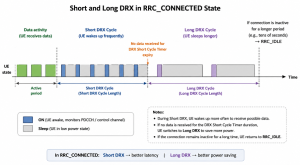
DRX operation in the RRC Connected state includes short DRX and long DRX cycles. Initially, the UE uses a short DRX cycle and wakes up more frequently to monitor the PDCCH for possible scheduling assignments. If no data is received during a predefined duration specified by the DRX short cycle timer, the UE transitions to the long DRX cycle, which provides greater power savings.
If the connection remains inactive for a longer duration, typically several seconds, the RRC connection may be released and the UE transitions to the RRC_IDLE state. Power consumption is lower in RRC_IDLE due to longer DRX cycles and reduced measurement requirements.
DRX can also support voice services. LTE enables very short DRX cycles so that the UE can receive voice packets that typically arrive every 20 ms.