IMS Centralized Services (ICS)
The objective of IMS Centralized Services (ICS) is to provide telephony services using IP Multimedia Subsystem (IMS)-based service enablers, independent of the access technology used by the end user. Specified in 3GPP TS 23.292, ICS enables consistent service delivery and a uniform access-agnostic user experience.
The IMS-based service enablers relevant in this context mainly include multimedia telephony services provided by the Telephony Application Server (TAS).
In addition to multimedia telephony, the IMS architecture supports several other service enablers, including:
- Presence services — provided by the Open Mobile Alliance (OMA) Presence Serve
- Service configuration and management — provided by the XML Document Management Server (XDMS)
- Instant messaging services — provided by the OMA Instant Messaging Server
These IMS service enablers are part of the Rich Communication Services (RCS) framework, a GSMA initiative aimed at enriching the end-user communication experience.
Future 3GPP standardization related to IMS is expected to build upon the ICS-based IMS architecture, including enhancements such as:
-
Multimedia Session Continuity (3GPP TS 23.237), enabling flexible control and continuity of individual multimedia streams by the UE and network.
- Reverse Single Radio Voice Call Continuity (reverse SR-VCC) (3GPP TS 23.216), enabling voice session continuity from UTRAN/GERAN to E-UTRAN
The ICS-based IMS architecture defines the principles for routing both originating and terminating sessions for an LTE subscriber using services provided by an ICS-enabled network.
In the ICS architecture, both originating and terminating sessions are routed through IMS, regardless of the access technology currently used by the served UE. This ensures that IMS remains the common service control point for session handling.
To support this architecture, appropriate access domain selection is required. The UE performs originating domain selection, while the network performs terminating domain selection to determine the suitable access technology for the session.
The domain selection process considers the requested session characteristics, such as voice, video, or other media types, along with the access domain capabilities currently available for the served UE.
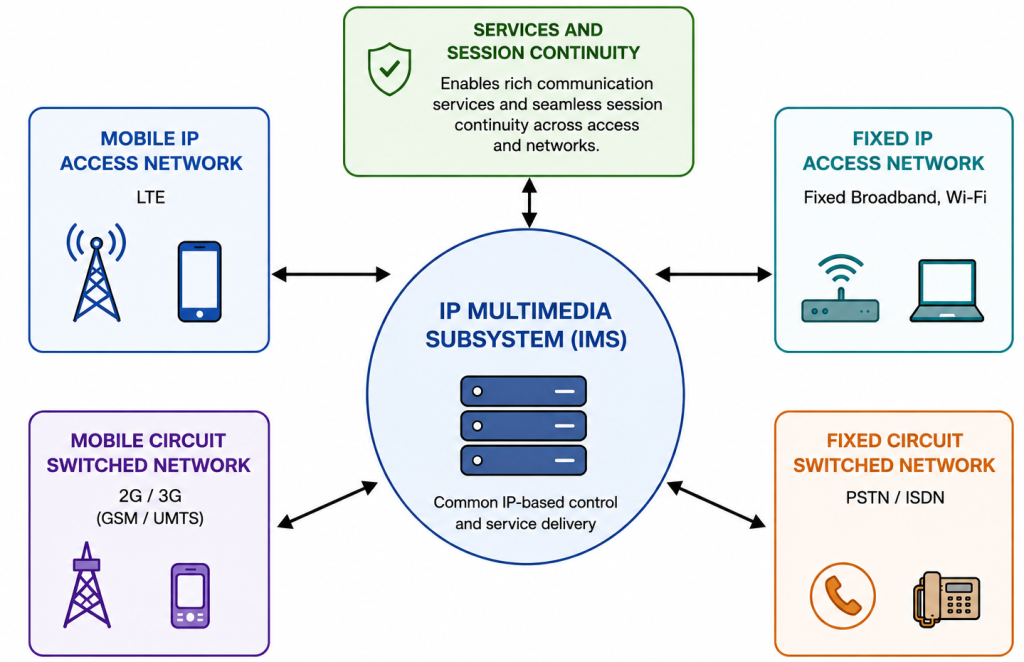
IMS multimedia telephony services can be categorized into two service levels:
-
Full multimedia telephony services: These provide advanced IMS capabilities by allowing additional media components, such as messaging or other multimedia content, to be included within the same IMS session along with voice or video. They also enable richer network-provided services compared with traditional circuit-switched networks.
- Circuit-switched equivalent multimedia telephony services: These represent a subset of full multimedia telephony services and provide a service capability equivalent to the telephony services available in existing mobile circuit-switched networks.
Service consistency for IMS-based services, including service execution and end-user experience, depends on the capabilities of the User Equipment (UE) as well as the specific services being provided.
The objective of ICS is to provide a consistent service experience by keeping service execution within the IMS domain as much as possible. The level of service consistency achieved depends on the capability of the UE to maintain IMS-based session control when operating over different access networks.
The following section describes how service consistency is achieved across different UE capabilities and service scenarios.
1. ICS-enhanced UE
An ICS-enhanced UE maintains IMS-based session control using Session Initiation Protocol (SIP) signalling over the Gm reference point, independent of the access technology used by the UE. Even when the UE is operating over a non-VoIP capable access network such as 2G or 3G, IMS session control is preserved while the circuit-switched (CS) access network may be used as the bearer for voice media.
This approach allows the UE to utilize the complete set of services provided by the ICS-based IMS architecture. Since SIP/Gm session control is maintained, enhanced IMS capabilities such as alphanumeric Uniform Resource Identifiers (URIs) and enriched session information can be supported during session establishment, which are not available through traditional CS call control procedures defined in 3GPP TS 24.008.
If packet-switched connectivity for SIP/Gm signalling towards IMS is unavailable, the UE can use the I1 reference point defined in 3GPP TS 24.294. The I1 interface uses Unstructured Supplementary Service Data (USSD) transport to support session control communication between the UE and IMS and enables switching between SIP/Gm and I1 when continuous packet-switched connectivity cannot be maintained.
2. Non-ICS-enhanced UE
A non-ICS-enhanced UE selects the service control mechanism based on the access network currently in use. It uses SIP/Gm-based IMS session control when connected through an IMS-capable packet-switched access network and traditional CS call control when operating over a CS access network.
Since service control depends on the selected access technology, available services are limited by the capabilities of that access domain. For example, in CS access networks, services are restricted to those supported by CS call control procedures defined in 3GPP TS 24.008.
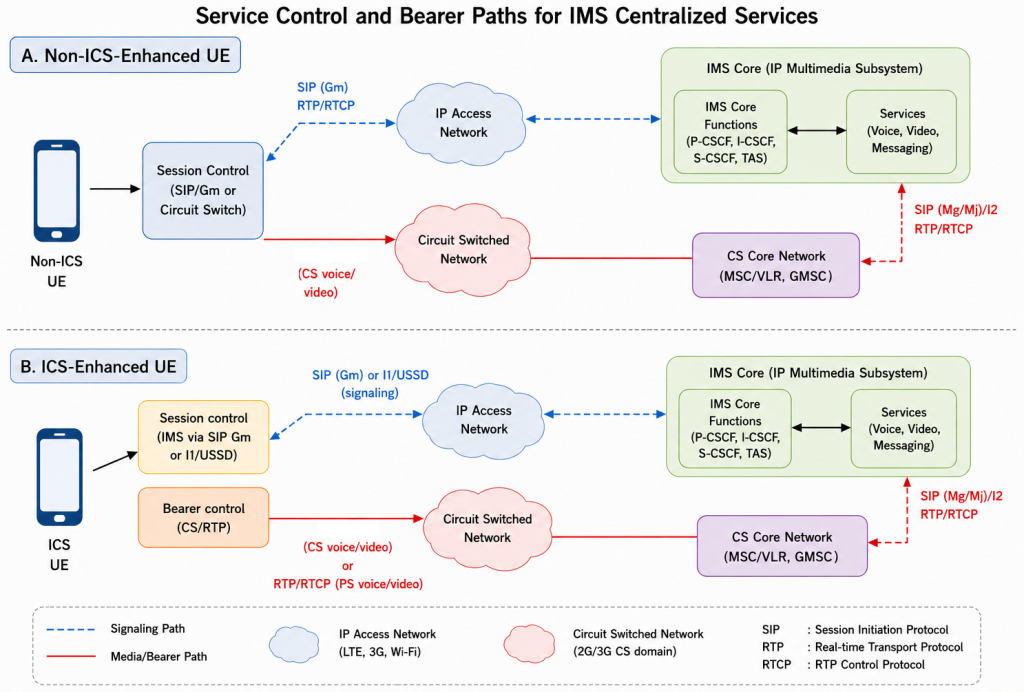
However, this limitation has minimal impact on IMS-based voice services such as Voice over LTE (VoLTE), as multimedia telephony services provided by the Telephony Application Server (TAS), based on GSMA IR.92, provide voice capabilities comparable to traditional CS mobile networks. Therefore, a consistent end-user voice experience can be maintained across different access technologies.
Initial VoLTE deployments commonly use IMS-capable VoLTE UEs without requiring ICS-enhanced UE functionality
3. Circuit-Switched (CS) UE
The third type of UE that can utilize services provided by an ICS-based IMS architecture is a native circuit-switched (CS) UE. These UEs represent traditional mobile devices deployed in large numbers and do not support SIP/Gm-based IMS session control or VoIP capabilities.
Since these UEs rely only on circuit-switched call control, the level of service consistency is lower compared with ICS-enhanced and non-ICS-enhanced UEs.
Table: ICS Service Capability Based on UE Type, Access Technology and Service Control
Note: Service capability is determined by the active service control domain. When SIP/Gm IMS session control is maintained, full IMS multimedia services can be supported. When CS call control is used, services are limited to CS-equivalent telephony capabilities
ICS Architecture Enhancements
To support IMS Centralized Services (ICS), 3GPP introduced several architectural enhancements that allow IMS to act as the common service control layer across different access technologies, including legacy circuit-switched networks.
A key component introduced for ICS is the Service Centralization and Continuity Application Server (SCC AS). The SCC AS is responsible for maintaining service continuity when sessions move between different access domains. It manages domain selection and performs domain or session transfer procedures when required, ensuring that IMS service control is preserved during access changes.
Another important enhancement is the ICS-enhanced Mobile Switching Centre (MSC) Server. It extends the functionality of the Release 4 MSC Server, originally designed for 2G/3G circuit-switched services, to enable integration with IMS-based service control.
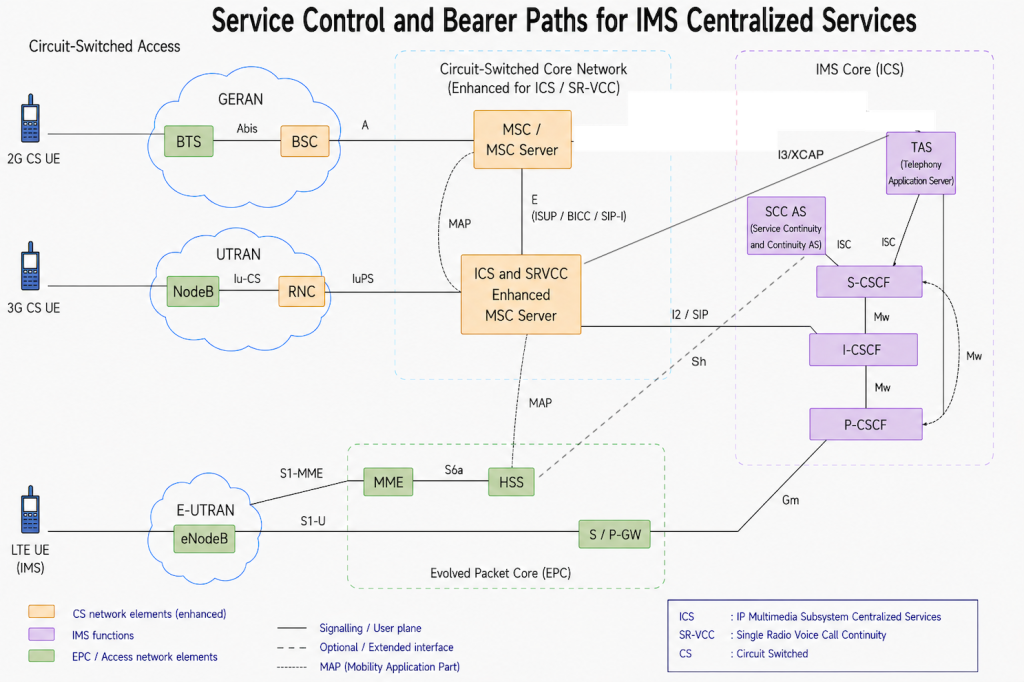
The ICS-enhanced MSC Server allows legacy CS UEs, which do not support SIP/Gm signalling or native VoIP, to access services provided by an ICS-based IMS architecture. It performs IMS registration on behalf of these non-IMS capable UEs, enabling IMS service entities such as the Telephony Application Server (TAS) and SCC AS to become aware of UE reachability.
This capability allows IMS-based routing principles to be applied directly for originating and terminating sessions. Without such functionality, additional mechanisms would be required to force CS calls through IMS for service execution.
The ICS-enhanced MSC Server also provides interworking between traditional CS supplementary service management and IMS-based service management. Supplementary service operations received from the UE using CS procedures (3GPP TS 24.010) are converted into XCAP-based IMS supplementary service control procedures defined in 3GPP TS 24.623 and TS 24.173.
With the evolution of SR-VCC from 3GPP Release 9 onwards, MSC Server functionality was further enhanced to support mid-call domain transfer between LTE/IMS and CS access. The SR-VCC-enhanced MSC Server uses the i2 SIP-based interface towards IMS, allowing it to provide functionality similar to the ICS-enhanced MSC Server for maintaining service continuity.
The ICS-enhanced IMS architecture enables operators to centralize telephony services in IMS and reuse the same service capabilities across different access technologies. This architecture forms the basis for VoLTE deployments. However, because the GSMA IR.92 VoLTE profile focuses on providing voice services comparable to existing circuit-switched services, ICS-enhanced UE capability is not mandatory for VoLTE operation.
Therefore, a VoLTE UE can still move outside IMS coverage and use available circuit-switched call control procedures while maintaining access to operator telephony services.
ICS also enables support for legacy circuit-switched UEs without SIP/Gm or VoIP capabilities. This concept is similar to the ETSI TISPAN approach used for fixed circuit-switched access to IMS through the Access Gateway Control Function (AGCF). For mobile CS access, the equivalent role is provided by the ICS-enhanced MSC Server.
Beyond providing CS-equivalent services, ICS-enhanced IMS architecture creates the foundation for introducing new IMS services that cannot be supported by traditional circuit-switched networks. ICS-enhanced UEs can take advantage of these capabilities through IMS technologies such as SIP-based service platforms and application development frameworks.
References:
1. Voice over LTE: VoLTE, First Edition. Miikka Poikselka, Harri Holma, Jukka Hongisto, Juha Kallio and Antti Toskala.¨ 2012 John Wiley & Sons, Ltd. Published 2012 by John Wiley & Sons, Ltd.
2. 3GPP Standards