Untrusted Wi-Fi Access
Release 6 introduced support for untrusted non-3GPP Wi-Fi access. Since Public Wi-Fi networks typically lack robust, operator-controlled security mechanisms, they are considered open and untrusted from a 3GPP perspective.
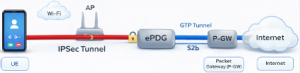
Wi-Fi access does not require modifications to the Wi-Fi Radio Access Network (RAN). Instead, it relies on an IPSec client on the User Equipment (UE). This client establishes a secure IPSec tunnel between the UE and the ePDG (Evolved Packet Data Gateway). The ePDG is further connected to the Packet Gateway (P-GW), where each user session is transported over a GTP tunnel via the S2a interface.
Voice over Wi-Fi (ePDG-Based Solution)
over Wi-Fi (VoWi-Fi) using the ePDG solution is an extension of IMS-based VoLTE services, enabling voice communication over Wi-Fi networks. Users do not need to distinguish between LTE and Wi-Fi access, as the system provides a consistent call experience equivalent to VoLTE. It also supports seamless handover between Wi-Fi and LTE networks.
Architecture and Call Flow
The User Equipment (UE) includes an ePDG client that initiates communication with the ePDG to establish secure connectivity.- A connection manager selects the access network (Wi-Fi or LTE) based on predefined logic and network conditions.
- A connection governor monitors connectivity events, such as LTE disconnection or Wi-Fi availability, and triggers appropriate actions.
- User identification is based on NAI (RFC 4282).
Wi-Fi is connected:
- The UE initiates IPSec tunnel establishment
- A secure tunnel is created, and the UE is assigned a virtual IP address
- IMS PDN connectivity is established
- The UE connects to the P-CSCF, performs IMS registration, and initiates a SIP session, After SIP session establishment, voice calls function identically to VoLTE calls.
Authentication and Security
is performed using IKEv2 and EAP-AKA, ensuring secure access to the operator network.
- The UE and ePDG negotiate cryptographic parameters, exchange nonces, and perform a Diffie-Hellman key exchange
- The ePDG forwards the user identity to the 3GPP AAA server
- The AAA server retrieves authentication vectors and user profile from the HSS
- It verifies whether the user is authorized for non-3GPP access Upon successful authentication, secure communication is established and services proceed as in VoLTE.
ePDG Discovery and Tunnel Establishment
ePDG connection can be established using dynamic discovery mechanisms:
- The UE constructs an FQDN (Fully Qualified Domain Name)
- It queries the DNS server to resolve the ePDG IP address
- Once resolved, the UE initiates IPSec tunnel establishment